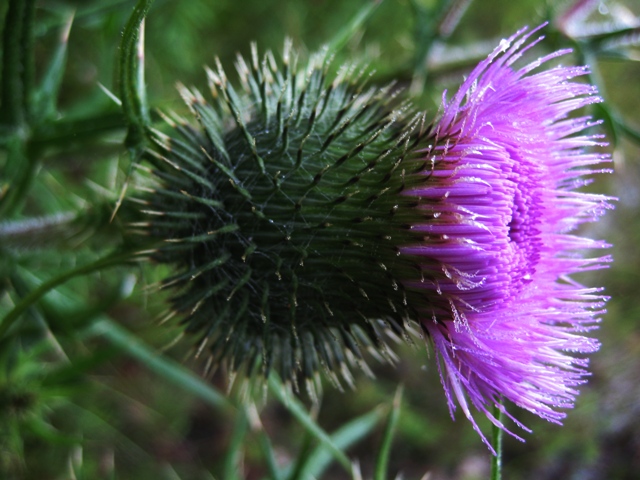
 This bull thistle is an apt symbol for contentious Township meetings. It’s shaped like a bullhorn, full of ouch, yet beautiful—not unlike democracy in action. (Someone said Democracy is a terrible system but the best one we’ve invented so far.)
As I waded through wet bull thistles taking pictures, I discovered a little drama at the heart of the flower, and decided that had metaphorical possibilities, too. Herewith, the Spider and the Fly, in which the Spider captures a Fly larger than itself and drags it off for no doubt nefarious purposes.
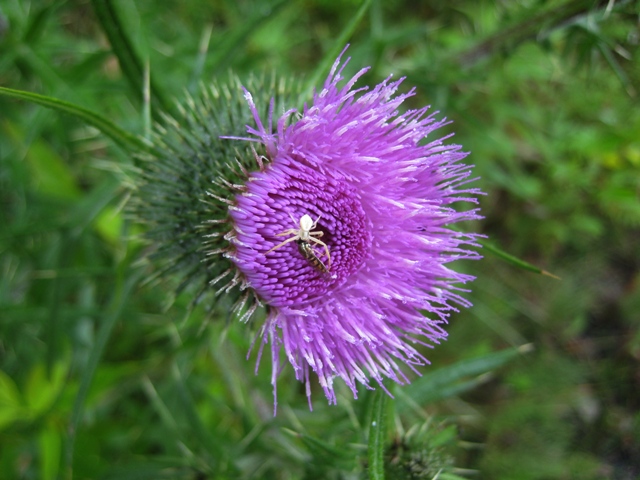
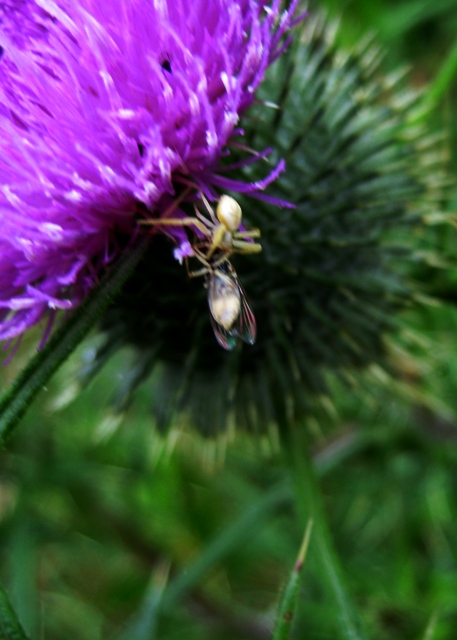
Make of that what you will. We’re headed for a run of bull thistle meetings in the Township, with fusses over phragmites eradication, over implementing the recommendations of the 2008 EMS Committee, over noise control . . . . That’s a lot of fusses, and we don’t want to start any new ones today. Let’s just wade into the first one.
Next Wednesday, July 29, at 6:00 pm at the Township Hall, the Board of Trustees will hold a special meeting to mull over whether to amend the phragmites eradication ordinance it adopted in June. Volunteers led by Tom Pierson have tentatively identified 70 patches of invasive phragmites along the Torch Lake Township bayshore. This past Tuesday the Board opened bids for the first treatment to eradicate those patches. The proposals were complex, and quotes ranged from $2,900-$9,600.
Talking the whole thing over with George Parker, I was surprised to learn that a number of phragmites patches have been identified along my usual beach route. I knew about only one. I went looking, and have decided that I need to learn more about the whole thing. Someone is misidentifying the stuff, and I wouldn’t be at all surprised if that would be me.
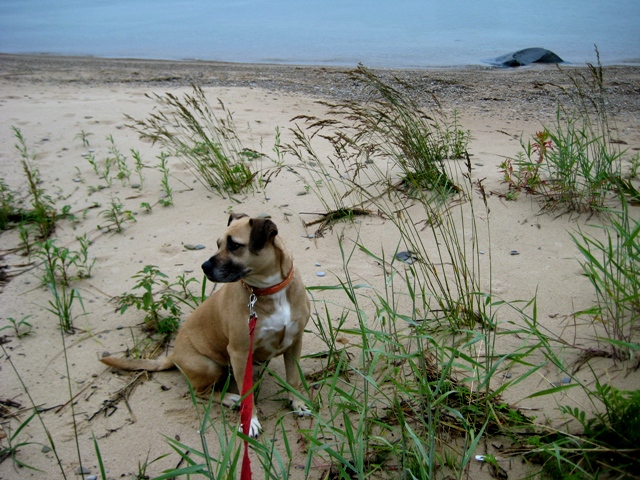
Is it or isn't it phragmites? Inquiring terriers want to know.
I’m going to ask Tom Pierson for a little guided tour of my favorite access spots. Meanwhile these are some of the places I’ve been looking for information:
- Rebecca Norris found a good Powerpoint presentation comparing native and exotic phragmites: Georgian Court Phragmites Powerpoint.
- The Michigan Department of Environmental Quality (MDEQ) has a whole section devoted to Control and Management of Invasive Phragmites. Thanks to Wally Juall and Alan Martel for forwarding the link to this site.
- Here’s a description of MDEQ’s Saginaw Bay Phragmites Control and Restoration Demonstration Project.
- I know you can find the Wikipedia entry for yourself, but here it is anyway: Wikipedia entry on Phragmites australis.
- There’s an indirect connection, but bear with me. Countering contamination with cattails from Freshkills Park blog is an argument for saving the cattails–and phragmites is crowding them out.
- Kevin Coyne of the New York Times published Weighing the Wisdom of Battling an Invader in the May 5, 2008 Going Coastal blog.
- Robert Pore, writing for the Grand Island Independent (Nebraska), reports that researchers from the University of Delaware have determined that phragmites produces a toxin that kills other plants, and becomes even stronger when exposed to the sun’s ultraviolet rays. This phenomenon is not all that unusual in nature, and has a name: plant allelopathy, which Pore describes as “the production of toxins by a plant to ward off encroachment by neighboring plants.” See Researchers: Phragmites has become a super weed. Newswise also printed a report on the same study by Harsh Bais and Thimmaraju Rudrappa: Changing Climate May Make ‘Super Weed’ Even More Powerful.
- The Glen Lake Association did a nice crisp post: Every Day Is Earth Day
- And then there’s this post on the Winterthur Garden (Delaware) blog about a practical use for phragmites: Faerie Cottage Re-thatching. So now what I want to know is whether I can harvest the stuff while it’s still flexible and weave it into baskets and fanciful forms. Look forward to posts about Phragmites Pharming.
Other Torch Lake Views posts about phragmites:
- Phragmites stories in the Elk Rapids News (a page reprinting articles I’ve published recently in the ERN)
- Expedition down Torch River to Skegemog
- Bugs, invading plants and the trouble with LUST
- Phragmites at the TBNP beach pond

 Torch Lake Views
p.j. grath
July 23, 2009
Your thistle photographs are wonderful, and since you segue from thistles to phragmites, I wonder if you’ve seen the list of invasive alien species that lists the bull thistle, while admitting that it “invaded” in Colonial days! And have you ever seen fields taken over by bull thistles as they are by star thistles (spotted knapweed by another name)? I cannot bring myself to deprive the goldfinches. As for phragmites, I dwell inland and am leaving that issue to others.
Gerry
July 23, 2009
These are the conundrums that would disrupt my sleep if I didn’t have more pressing worries. When I opened your comment I trotted off to see what lists I could find, and was dismayed to read things like “180 invasive species in the Great Lakes basin.” Well, now, at what point do we simply recognize that what was was and is no more? Lots to mull.
flandrumhill
July 24, 2009
Good grief! Who would have ever thought that plants could offer so much drama! I must say I’ve been in the dark with regards to phragmites until reading this post. Now you’ve got me wondering if we have phragmites along our beaches. Must check out your links and investigate.
The thistle/fly homicide photos are lovely. Some countries, ie. South Africa, have become very pro-active of late in ridding themselves of non-native species. Lots to mull indeed.
Gerry
July 24, 2009
Well, how on earth do we define “non-native”? Plants that came over on the Mayflower have been here 400 years. Presumably the rest of the environment has had enough time to adjust. Do I sound cranky this morning? I am. I stayed up way too late reading those lists and then took the dogs for their walk this morning and looked at beach and roadside with new eyes. Let’s see, non-natives . . . Mullein, Queen Anne’s Lace, Chicory, Burdock, Crown Vetch, St. Johnswort, Forget-Me-Not, Bouncing Bet, Butter and Eggs, Bladder Campion (which I misidentified as Bouncing Bet–sorry–but they’re both non-native anyway), White Campion, White Clover, White Sweet Clover, Yellow Sweet Clover, Red Clover (which I always call Purple Clover–sorry), Spotted Knapweed, Winter Cress, Ox-eye Daisy, Orange Hawkweed, Yellow Hawkweed, Ground Ivy, Tansy, Wild Parsnip, Dandelion, Moneywort, Everlasting Pea, Alfalfa, Periwinkle, Curly Dock, Yellow Sedum, Alfalfa, Orange Day Lily (Tiger Lily). And that’s just the flowering plants. We won’t even get into the grasses, I’m too depressed and I don’t have time to go take a nap.
centria
July 24, 2009
I, for one, refuse to jump into the invasive/non-invasive arena and choose sides. (oh yeah, right, just when I say that…it will probably happen…) I mean, WE are invasive species, are we not? Some species are simply world travelers. I am heading to the Pow Wow tonight and am simply hoping not to be labeled as an invasive species. Or at least snubbed or labeled or lynched for it. Ooops, maybe I should take a nap before heading over there, Gerry.
Gerry
July 24, 2009
I found that some sites don’t classify plants as native/non-native, but as native/”introduced” (Chicory, meet Dutchman’s Breeches . . . ). I have no idea how they classify plants that have not been properly introduced. “Cheeky” probably. Some lists classify both native and introduced species as invasive when they are. So, for example, when pineapple weed takes over your lawn, it’s invasive, but an invasive native . . .
I am envious of your attendance at the Pow Wow tonight. One of my peak experiences was attending that very Pow Wow on the Keewenaw Bay, probably in 1996 or so. I wasn’t sure I would be welcome to attend, so I asked around . . . OK, I could go. I arrived very early and wandered around vendors’ row, sampling corn soup and frybread and good coffee as mist swirled in the woods and sleepy families started their campfires. Sweetgrass perfumed the air. By the time the first Drum began for the Grand Entry, I was in an altered state. That first cry, thrown to the sky, took my very heart with it, and I’ve never forgotten it.
The next year I brought a friend who was Polish on her mother’s side and Mohawk (from the Oka reserve, outside Montreal) on her father’s side. Margaret made me dance. She told me about going to her dad’s family in the summer, and attending a powwow that was basically a family reunion. She said it was very informal and very traditional. One year, she said, a group of Japanese traditional drummers attended. That was one of her peak experiences. She said the drummers got together and traded techniques and ideas and . . . it was all very intense and yet normal, if you know what I mean. They were just . . . showing each other how they did the same thing . . . but different. When I went to see Nagata Shachu at the Dennos Museum in TC I understood at once. Another peak experience.
Isn’t this world we’ve invaded a wonderful place?
dmarks
July 24, 2009
So that is what a thistle is.
I have some more postcards of old Detroit up on my blog.
Gerry
July 24, 2009
Nope. That’s what a bull thistle is. There are lots of other thistles, too, and the Cowboy has samples of many of them in his curly fur. I went and looked and you do have some very cool vintage Detroit postcards posted.
flandrumhill
July 25, 2009
Oh my Gerry… that’s quite the list of non-native species. I think Dandelions are probably also on some people’s lists of ‘invasive non-natives.’
centria
July 25, 2009
Gerry, we probably saw each other those years when you came to the Pow Wow. What a thought! I am having a dreadful case of nerves. Last night I went to the Pow Wow and could not, could not, find the courage to take pictures. But all sorts of people are all interested to see photos of the Pow Wow…so am heading back and TRYING to get the courage to do so. I have been thinking bout your Pow Wow stories since last night…
Gerry
July 25, 2009
I think you’ll do fine. Ask. (I seem to recall that there were general announcements about when/where it was and was not appropriate to take pictures.) Those powwow grounds are just beautiful. I’ll look forward to seeing your images!
Back in the day, I wasn’t taking photos and blogging. Amazing how many pictures remain in my mind. ‘Course I can’t share ’em unless I learn to draw as Amy does.
flandrumhill
July 25, 2009
Ha ha Gerry. Kathy, I think you should consider buying one of those James Bond type secret cameras that fit into lighters or pens.
My dad was a photographer journalist and was ALWAYS taking people’s photos. One of my sisters is the same way. I don’t think it ever dawned on either of them that someone might NOT want to have their picture taken. In the news today the Hutterites in Alberta were in a kerfuffle over having to have their photos taken for drivers licenses. The province told them they still had the option to hire chauffeurs if they didn’t want to comply.
Gerry
July 25, 2009
Oh my – talk about prickly issues.