It was time for an update on Providence Farm. We dropped in to see what was ready for members’ baskets this week. Lettuces, kale, snap peas, sugar peas, garlic scapes and beets were piled on the shelves. Strawberries from another organic farm in Lodi were on offer.
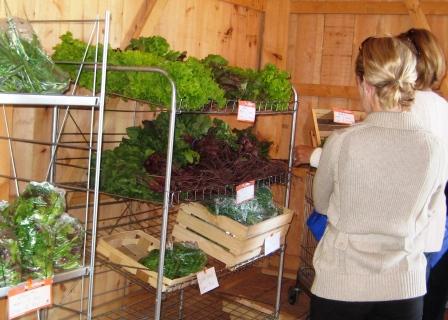
You probably don’t introduce your children to the CEO of your favorite supermarket chain, but when you belong to a CSA early summer is Family Reunion time. You do introduce them to Andrea and Ryan Romeyn.

People turned to carry their produce off and stopped still to admire the scenery: the tidy rows of vegetables flowing toward Torch Lake, the daisies bobbing in the breeze, the blue spikes of . . . what are those blue wildflowers? Andrea didn’t know. “We just keep track of the cultivated plants,” she laughed. Ryan didn’t know. “People ask me that all the time. I don’t know.” (You have to love a man who can say “I don’t know” and mean it.) Clearly an investigation was in order.
Mary Lee Bretz and I both offered to identify the mystery guest, but only one of us has a camera surgically implanted on her person. I trotted off toward the flower spikes. “Don’t touch the fence!” Ryan warned. It’s electrified in order to give marauding deer a nasty shock.
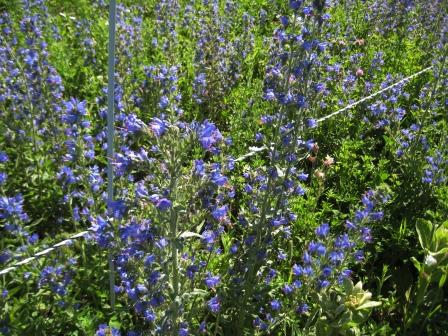
Then I got a close up look at the plant. Spiky. Those hairy spikes that bury themselves in your skin and itch painfully for a long time. I persevered.
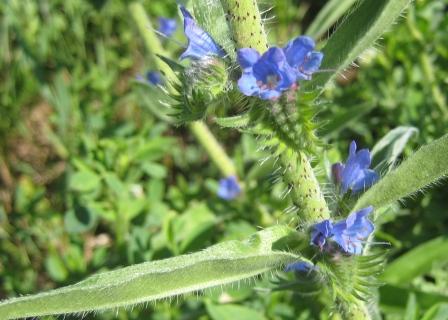
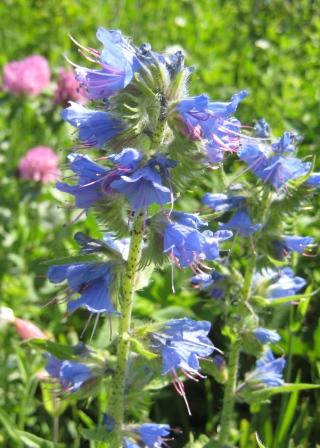
I looked through my Peterson’s Field Guide and had my suspicions, but it was only when I found Brian Johnston’s amazing essay that I was confident. I say it’s Viper’s Bugloss (Echium vulgare). Johnston, a Canadian who published his work on Microscopy-UK, has my utmost respect, and if you go see his stunning, detailed images of wildflowers accompanied by crystal clear text, he will have yours as well.

 Torch Lake Views
katherine
July 4, 2009
Yes, that’s what it is… I love the stuff, also chicory that grows along the side of roads here.
leslie
July 4, 2009
Hey – just coming by to say hi. 🙂
I am on two weeks school holiday – thank God!!
p.j. grath
July 4, 2009
Yes, that’s it, all right. The first time I identified it, years ago in an orchard, between the rows of cherry trees, David accused me of “making up” the name. Well, despite its prickles, it’s worth picking with gloves on, as it lasts well in arrangements, and as you see the blue fades to a lovely pink as the blossoms age. (Would that we could do the same!)
p.j. grath
July 4, 2009
Omigosh! I should have looked at the Johnston essay and photographs before leaving a comment. If he says pink before blue, I’m sure he’s right, and I’ve been once again a careless observer. But thanks for that link, as well as for your own images, Gerry.
Gerry
July 4, 2009
That’s interesting, because I too seem to recall that these “fade” to pink. The fresh buds are pink before they open, but once they unfurl they’re blue. I guess I’ll have to go back to cut a bouquet and see what happens!
Katy
July 8, 2009
Okay, I just “spent” another hour following the link to Brian Johnston’s TRULY amazing description; I will have to dole out some of his other (chicory being one) flowers as a reward for doing some real work. You are a conduit to much pleasure, Gerry.
Gerry
July 8, 2009
Thank you, ma’am. One might say the same of you and Bayview Farm.