There were wild turkeys in the driveway when I got up this morning. One big tom strutted about in full display for the hens. Look at me I’m just so gorgeous. He was so comical I missed the photo but they’ll be back.
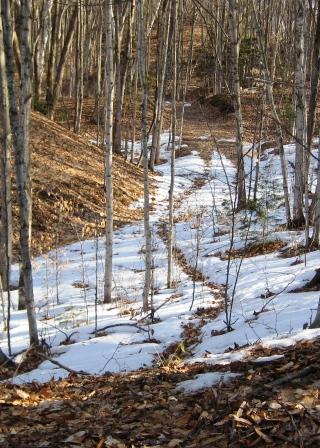
Our walk took us into the drumlins behind the Writing Studio & Bait Shop where only a little snow remains. We followed a deer trail, the Cowboy in a high state of excitement.
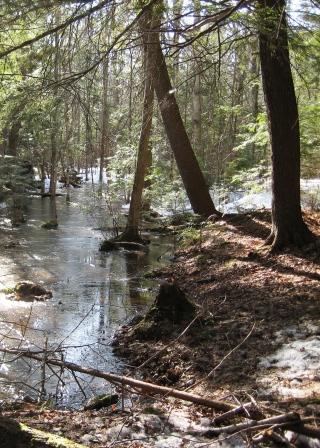
We explored the mysterious wetlands that will make a wonderful mosquito nursery as soon as it warms up.
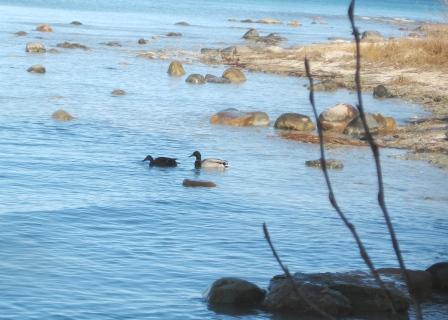
Coming back along the bayshore we found some mallards feeding.
Finally we documented a troubling phenomenon. That green stuff is Cladophora, a rooted aquatic plant that has become a stinky nuisance on Great Lakes beaches in recent years. The Watershed Center is investigating the association between cladophora and avian botulism. Other studies find an association between cladophora and E. coli levels on our beaches. It’s just like everything else. A little is innocuous, even interesting. A whole lot is a mess.
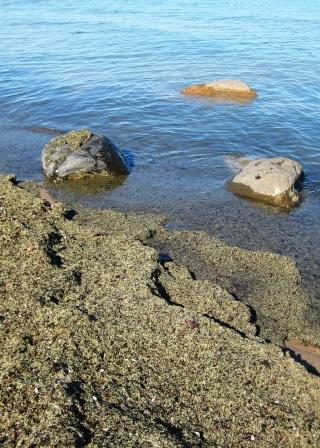
The theory is that invasive zebra and quagga mussels have filtered tiny organisms out of the water, leaving it unusually clear. The clarity allows sunlight to reach the bottom, encouraging the growth of cladophora out of all proportion to the need for the pesky stuff. Dying mussles contribute a lot of phosphorous, which further encourages the weedy growth. Then the cladophora washes up on the beach, carrying mussels and crayfish with it. Gulls and ducks and Canada geese are attracted to the seafood buffet. The whole mess cooks in the sun a bit, leaving a decaying mass of alga, dead mussels, dead crayfish, and waterfowl poop. Smells like a sewer when that happens. So far the only thing we know how to do with it is to rake it up and bury it inland. Ah, springtime.

 Torch Lake Views
katherine
April 10, 2009
Not only the gulls, ducks and Canada geese, every dog I’ve ever walked likes to either eat it or roll in it, sometimes both.
Gerry
April 10, 2009
I must confess that the Cowboy has been doing quite a lot of rolling in things this week. Miss Sadie is somewhat more fastidious, although I suspect her of sneaking a roll behind my back every now and then. Neither of them is exactly fragrant. We are going visiting next week. I’d best get them to Dirty Dawgs for a little grooming session.
La Mirada Bob
April 10, 2009
OK, Gerry. I looked at the list of businesses and then all the other sidebars but did not see a link to Dirty Dawgs. Please let us know about that enterprise.
Gerry
April 11, 2009
Ah. Dirty Dawgs is a dog-grooming parlor in Elk Rapids. It’s a lot of work keeping up links, so I limit the business list to those operating in the Township, even though I write about some that are outside it (Friske’s, the Treasure Chest).