I like knowing where my food comes from. I like fruit picked at the right time, just ripe enough that it will finish sweetening in my fruit bowl, but not so ripe that I have to eat it all that day. (Except peaches. I will buy peaches that I have to eat that minute. I am a fool for peaches.) I like talking to growers about how to store my bushel of Galas and how to tell when the Bosc pears are most delicious. I like honey and maple syrup and preserves produced right here, by families I know.
Next year I am going to have a proper freezer, because next summer I am going to freeze some ethereal Antrim County corn – and a lot of peaches and cherries and blueberries, too. And Cora Stoppert says she’ll teach me how to can things so I don’t poison myself.
Why am I going on about this? I’ve decided that what I eat – which is one of the few things in my personal control these days – makes a difference in the world beyond my own kitchen. Best of all, I don’t have to wait around for some piece of legislation or an Official Policy Statement – I can just go ahead and do sensible things. What a concept.
I am indebted to Susan Och of Lake Leelanau, whose French Road Connections post sent me to one of the most thought-provoking essays I’ve read in a long time: Michael Pollan’s Farmer in Chief. Pollan argues that refocusing food production on variety rather than monoculture, using sustainable practices, and choosing to eat food grown in our own neighborhoods (or even in our own yards) can profoundly influence our national security, our health and our economy. Some of it didn’t persuade me, particularly the bits about grants and policy engineering, but I can relate to the underlying vision.
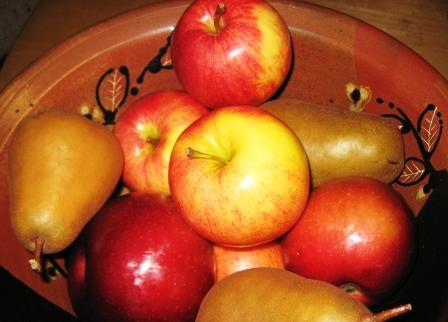
This stuff doesn’t work so easily for everyone, but here in Antrim County we’re lucky. If we want to, we can get personally acquainted with the chickens who lay our eggs. We can pull over on the side of the road and admire the cornfields and potato fields and orchards that feed us. When we take our newspapers to the recycling center, we know they’re going to be shredded for bedding for Marv Rubingh’s cows. What I liked about Pollan’s essay was all the ideas it gave me about what we can do as individuals and small communities, even in the absence of the kinds of overarching policy initiatives he loads on top. I thought you might like the essay, too. Even if you don’t, I’ll bet you’d like Antrim County apples and pears.
Definitely related posts (added 10-18-08 so Jane Louise can see pictures of the produce!):

 Torch Lake Views
Leslie Smyers in Australia
October 17, 2008
Good early morning from cool Canberra!
You just gave me an idea for the latest class photo competition – we will do Welcome Spring. 🙂
Um, our seasons being upside down to yours. 🙂
Jane Louise
October 18, 2008
Barbara Kingsolver wrote a great book called “Animal, Vegetable, Miracle”. Her family made a decision to live for a year, eating only the food they grew themselves, or within a fifty mile radius. (She couldn’t give up coffee). It is inspiring. I felt like going out & planting the whole yard in tomatoes & green beans. I have stopped at every road-side stand this summer, even Bill’s in Petoskey,looking for the perfect tasting old-fashioned tomato. Tell me if you have found it.
Jane Louise
October 18, 2008
I would love weekly pictures of your CSA haul. We could be inspired to join.
Gerry Sell
October 18, 2008
Leslie, I’ll be interested to see what your classes post on signs of spring in Canberra. It’s all about paying attention, isn’t it?
Jane, I didn’t take pictures of my produce every week, but I did take a couple snapshots, and I’m going to edit the post to include those links.
Sadly, I did not find the perfect old-fashioned tomato, although I had some tasty ones. I think there might have been some, except that it wasn’t really good tomato-growing weather this year. A number of local orchardists are growing heirloom varieties of apples. I wonder if anyone is growing heirloom tomatoes? Must investigate.
Barbara Kingsolver is one of my favorite writers. I’ve given some thought to eating from a fifty-mile radius (and tell myself locally roasted coffee qualifies!) Maybe once Cora teaches me to can I’ll be able to do it.